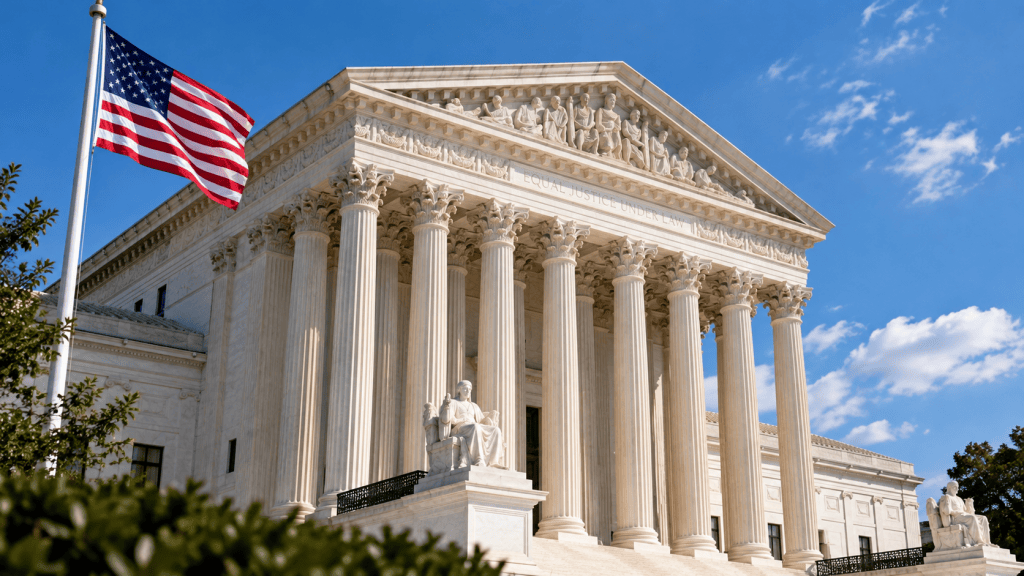
A Supreme Court emergency order has revived New Hampshire’s restrictions on student identification cards, raising questions about election security, voting access, and judicial intervention just days before the November 3 elections.
What Happened?
On October 22, 2026, the U.S. Supreme Court allowed New Hampshire to enforce restrictions preventing voters from using student identification cards to establish their identity in the upcoming midterm elections.
The decision came after state officials appealed a federal district court ruling that had partially blocked the state’s interpretation of a newly enacted voter identification law.
The Supreme Court’s unsigned emergency order temporarily halted the lower court’s ruling, allowing New Hampshire’s restrictions to remain in effect while litigation continues.
Justice Ketanji Brown Jackson was the only justice to publicly dissent.
The decision comes less than two weeks before voters head to the polls in an election that could determine control of Congress.
Understanding New Hampshire’s Voter ID Law
Earlier this year, New Hampshire enacted legislation removing student identification cards from its list of expressly accepted forms of identification for voting.
The law requires voters to establish their identity using acceptable documentation, including qualifying government-issued identification.
However, the dispute extended beyond whether student IDs could be accepted on their own.
New Hampshire’s election procedures contain an alternative verification process, sometimes described as a safety valve, allowing election officials to consider other evidence when voters lack standard identification.
Secretary of State David Scanlan issued guidance prohibiting election officials from considering student IDs even as supporting evidence through that alternative process.
Voting rights advocates challenged the interpretation, arguing that state officials had imposed restrictions extending beyond what the legislation required.
A federal district court agreed in part, leaving the underlying voter ID law intact while blocking the secretary of state’s additional guidance.
The state appealed, eventually bringing the dispute before the Supreme Court.
Why the Supreme Court Intervened
The Supreme Court’s decision focused primarily on the timing of the lower court’s intervention.
The justices relied on a legal principle commonly known as the Purcell principle, which generally discourages federal courts from changing election rules shortly before an election.
The underlying concern is that last-minute judicial intervention can create confusion among voters and election administrators.
The Court concluded that the lower court had not sufficiently justified departing from that principle.
Importantly, the emergency order did not represent a final ruling on whether New Hampshire’s interpretation of its voter identification law is constitutional.
The broader legal dispute remains unresolved.
The Argument for Stricter Voter Identification
Supporters of the restrictions argue that election officials should rely on identification issued under consistent and verifiable standards.
Republican state Representative Donald McFarlane, who sponsored the legislation, argued that educational institutions do not necessarily follow the same identity-verification procedures as government agencies.
Supporters maintain that restricting acceptable identification can strengthen consistency, reduce opportunities for identity-related irregularities, and improve public confidence in elections.
New Hampshire Attorney General John Formella also defended the Supreme Court’s decision, arguing that last-minute changes to election procedures could create uncertainty for voters and election workers.
From this perspective, the dispute is about maintaining clear and predictable election rules rather than preventing eligible students from voting.
However, the existence of different identification standards does not, by itself, establish that student IDs have contributed to widespread voter fraud.
That distinction is important when evaluating the policy’s effectiveness.
The Argument Against the Restrictions
Voting rights advocates argue that excluding student identification cards creates unnecessary obstacles for eligible voters, particularly younger citizens.
College students may possess valid school identification but lack another qualifying document immediately available at the polling place.
Opponents also question whether restricting student IDs provides a measurable election-security benefit.
Their argument is that voting regulations should address demonstrated risks without unnecessarily burdening eligible voters.
Justice Ketanji Brown Jackson’s dissent focused on the Supreme Court’s application of the Purcell principle.
Jackson argued that the lower court had not changed the underlying election law but had instead sought to correct state guidance that potentially misrepresented its requirements.
From that perspective, the lower court’s intervention was intended to prevent voter confusion rather than create it.
Voting rights advocates also warned that changing the guidance again shortly before Election Day could itself create uncertainty.
What Does the Evidence Establish?
Several important distinctions emerge from the available reporting.
First, New Hampshire has the legal authority to establish voter identification requirements, subject to constitutional and federal legal limitations.
The central dispute in this case concerns how those requirements are interpreted and enforced.
Second, the Supreme Court’s emergency order does not establish that student identification cards are inherently unreliable.
The decision primarily addresses whether a federal court should intervene in election procedures so close to Election Day.
Third, the number of voters who may be affected remains uncertain.
Some local election officials have indicated that relatively few students attempt to vote using only school-issued identification.
However, that observation does not establish the statewide impact of the restriction.
Finally, neither side’s broader political claims should be confused with the Court’s actual decision.
The ruling allows the restrictions to operate during the election. It does not resolve every constitutional question raised by the lawsuit.
Could the Decision Affect the Midterm Elections?
New Hampshire is holding a closely watched U.S. Senate election, making voting procedures particularly relevant.
Younger voters have historically shown different political preferences from older voters, but that does not establish how many ballots, if any, will be affected by this specific restriction.
A meaningful assessment would require reliable information about how many eligible voters lack acceptable alternative identification and whether the restriction prevents them from voting.
Without that evidence, claims that the decision will determine the election outcome would be speculative.
The On Points Politics Assessment
What the evidence establishes:
The Supreme Court has temporarily allowed New Hampshire to enforce its restrictions on student identification cards during the November 3 midterm elections.
The decision relies primarily on concerns about judicial changes to election procedures shortly before voting.
What remains disputed:
Whether the state’s interpretation of its voter identification law is legally justified, whether student IDs present meaningful security concerns, and how many eligible voters may be affected.
What the ruling does not establish:
The Supreme Court has not issued a final determination that the underlying restrictions are constitutional, nor has the decision established that student identification cards are associated with widespread election fraud.
Bottom Line
Election security and voting access are legitimate public interests that must be evaluated together.
Supporters of New Hampshire’s restrictions emphasize consistent identification standards and predictable election administration.
Opponents emphasize the potential burden on eligible voters and question whether the restrictions address a demonstrated problem.
The Supreme Court has settled which rules may be enforced for the upcoming election, but the underlying legal and policy debate remains unresolved.
On Points Politics — Facts First. Perspective Without Partisanship.
Sources
- Associated Press — October 22, 2026. Supreme Court allows New Hampshire to fully ban student IDs for voting in midterms.
- New Hampshire Public Radio — October 23, 2026. U.S. Supreme Court blocks use of student IDs for voting in NH.
- Courthouse News Service — October 23, 2026. Supreme Court signs off on GOP officials’ student ID voting ban in New Hampshire.
- CBS News / Associated Press — October 22, 2026. Supreme Court rules New Hampshire can ban use of student IDs for midterm voters.

